Using Mobile Application Development Services to Improve Customer Engagement
Business Scenario
A growing service-based business is experiencing a common digital challenge: its customers increasingly expect faster, more convenient, and mobile-first interactions, while many of its existing processes still depend on a website, phone calls, emails, and manual follow-ups.
The business wants to introduce a dedicated mobile application that gives customers a simpler way to access services, submit requests, receive updates, and communicate with the company. At the same time, its internal team needs a centralized system to manage customer activity and reduce dependency on disconnected processes.
To address these requirements, the company considers partnering with DashMindsIQ for Mobile Application Development Services.
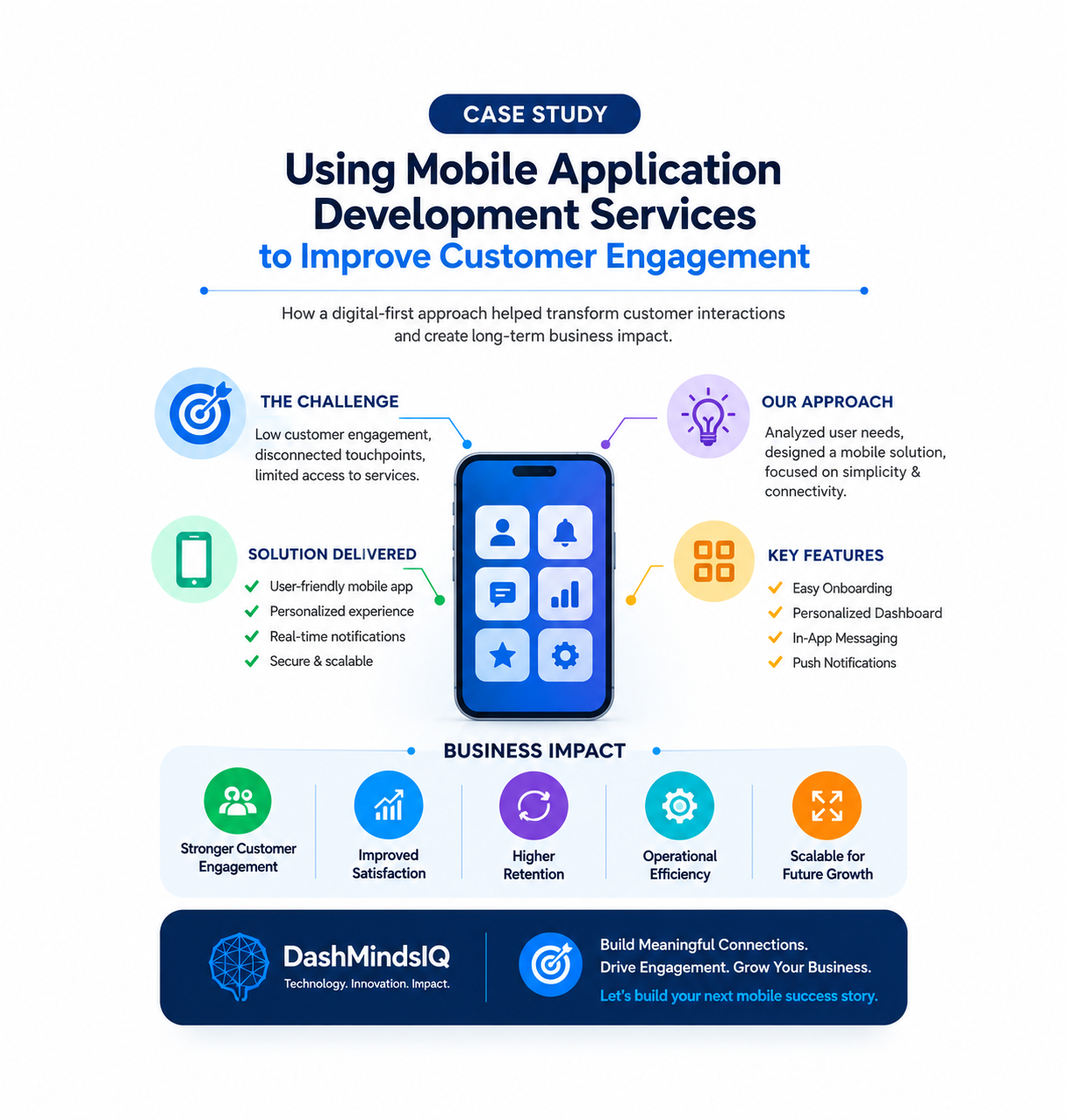
Important: This is a hypothetical business scenario created to demonstrate how DashMindsIQ's mobile application development approach could be applied. It does not represent an actual client project or guaranteed business results.
The Business Challenge
The company already has an established customer base but faces several digital experience and operational challenges:
- Customers have limited access to services through mobile devices.
- Important interactions depend on emails, calls, or website visits.
- Customers may have difficulty tracking requests or receiving timely updates.
- Internal teams work across multiple systems and communication channels.
- The existing digital experience is not sufficiently optimized for mobile-first users.
- The business wants a scalable application that can support future features without requiring a complete rebuild.
The company understands that simply creating a mobile app is not enough. It needs an application that aligns with its business processes, customer expectations, security requirements, and long-term growth plans.
This makes selecting the right Mobile Application Development Services provider an important business decision.
Business Requirements
Before development begins, the business identifies several core requirements for its mobile application.
Customer-Facing Application
The application should provide customers with a convenient mobile interface for:
- Account registration and secure login
- Profile management
- Service discovery
- Request or order submission
- Status tracking
- Notifications and updates
- In-app communication or support
- Secure information access
Business and Administrative Capabilities
The company also requires:
- Centralized application management
- Integration with existing business systems
- Secure data handling
- User and role management
- Analytics and reporting capabilities
- A scalable backend architecture
- The ability to add new functionality in future releases
Rather than developing features independently, the company needs a coordinated mobile app development strategy connecting the customer experience with its operational infrastructure.
DashMindsIQ's Recommended Approach
DashMindsIQ would begin with discovery rather than immediately moving into development. The objective is to understand what the application needs to accomplish for the business and its users, not simply what screens need to be built. The recommended approach would include:
1. Business and User Discovery
The team would evaluate:
- Business objectives
- Target users
- Existing customer journeys
- Current technology infrastructure
- Operational pain points
- Application requirements
- Security considerations
- Integration requirements
- Future scalability needs
This helps establish a clear product roadmap before development resources are committed.
2. UX/UI Planning
The application experience would be designed around simplicity and usability. User journeys, wireframes, navigation structures, and interface concepts would be developed to create a consistent experience across supported devices. The focus would be on reducing unnecessary steps and making important actions easy to find.
3. Technology and Architecture Selection
Depending on the business requirements, DashMindsIQ could evaluate appropriate approaches such as native iOS and Android development or cross-platform frameworks such as Flutter or React Native. The decision would be based on factors including:
- Required functionality
- Performance expectations
- Platform requirements
- Integration complexity
- Development and maintenance considerations
- Future scalability
This prevents technology selection from becoming disconnected from the actual business objectives.
Proposed Mobile Application Solution
Based on the scenario, DashMindsIQ would develop a mobile solution consisting of three connected components.
Customer Mobile Application
The mobile app would serve as the primary customer interaction channel. Potential capabilities could include:
- Secure authentication
- Personalized dashboards
- Service browsing
- Digital request submission
- Real-time status visibility
- Push notifications
- Customer support
- Account management
The exact functionality would be determined during the discovery and requirements phase.
Backend and API Layer
The backend would connect the mobile application with the company's existing systems. APIs could be used to securely exchange information between the application, backend services, databases, and third-party platforms where required. This architecture would allow the company to expand application functionality without making the entire system dependent on a single component.
Administrative Interface
An administrative system could allow authorized employees to manage customer requests, application content, users, notifications, and relevant operational information. This creates a connection between the customer-facing application and the company's internal processes.
Implementation Process
A structured mobile application development process would help the business reduce unnecessary development risks.
Phase 1: Discovery and Requirements
Business goals, user requirements, workflows, integrations, technical requirements, and project scope would be documented.
Phase 2: UX/UI Design
The user experience and application interface would be planned and reviewed before development.
Phase 3: Application Development
Development would proceed in defined stages, covering the mobile application, backend services, APIs, integrations, and administrative functionality.
Phase 4: Testing and Quality Assurance
The application would be evaluated for:
- Functional performance
- Usability
- Device compatibility
- API and integration behavior
- Security considerations
- Application stability
- Performance issues
Phase 5: Deployment
Once the application meets the agreed requirements, the deployment process would cover the relevant app stores, backend infrastructure, configurations, and production environment.
Phase 6: Post-Launch Improvement
Mobile applications are not one-time projects. User feedback, analytics, business requirements, and technology changes can create opportunities for continuous improvement. A post-launch roadmap could therefore include feature enhancements, performance optimization, security updates, and additional integrations.
Expected Business Benefits
Because this is a hypothetical scenario, no specific performance statistics or financial outcomes are being claimed. However, a properly planned mobile application could help the business pursue several potential benefits:
Better Customer Experience
A dedicated mobile channel can make frequently used services easier to access and reduce friction in customer interactions.
More Convenient Communication
Push notifications and in-app communication can provide customers with a more direct way to receive relevant updates.
Improved Operational Visibility
Connecting customer-facing functionality with backend systems can give internal teams better visibility into requests and activities.
Scalable Digital Infrastructure
A well-designed architecture can provide a foundation for adding future features and integrations as business requirements evolve.
Stronger Mobile Engagement
A dedicated application can create an additional digital touchpoint through which businesses can engage existing customers.
Why the Right Mobile App Development Partner Matters
Choosing a Mobile Application Development Services provider should not be based only on development cost or the ability to build an application. Businesses should evaluate whether a technology partner can understand:
- Their business model
- Their customers
- Their existing technology environment
- Integration requirements
- Security needs
- Scalability objectives
- Long-term product strategy
A technically functional application that does not solve the underlying business problem may deliver limited value. DashMindsIQ's approach is therefore positioned around connecting business strategy, UX/UI design, application development, integrations, and ongoing improvement rather than treating mobile development as an isolated coding project.
Key Takeaways
This business scenario demonstrates several important considerations for companies planning a mobile application:
- Start with the business problem, not just the desired app features.
- Understand users and their journeys before designing the application.
- Select technology based on business requirements, scalability, and platform needs.
- Plan integrations early when the application needs to connect with existing systems.
- Prioritize security, usability, and performance throughout development.
- Treat the application as a long-term digital product, not simply a one-time development project.
- Choose a development partner that understands business objectives, not just technical implementation.
Considering a Mobile Application for Your Business?
If your business is relying on outdated digital processes, disconnected customer interactions, or a website that cannot deliver the mobile experience your customers expect, a purpose-built application could be the next step in your digital strategy. DashMindsIQ provides Mobile Application Development Services designed around your business requirements, user experience, technology ecosystem, and growth objectives. Whether you are planning a new mobile application, modernizing an existing app, connecting mobile experiences with enterprise systems, or exploring cross-platform development, the right strategy can help you move from an idea to a scalable digital solution. Ready to explore what a mobile application could do for your business? Contact DashMindsIQ today to discuss your requirements and discover a mobile application development approach tailored to your business goals.
Have a Technical Challenge Worth Discussing?
Our practice leads are happy to talk through your specific situation — no sales pitch required.